Empathy explorations
As our school transitions to a new curriculum, conversations with teachers in my role as an Ed Tech and Innovation Coach have revealed a consistent challenge. Teachers are struggling to differentiate for students’ learning needs while building new lessons and resources for the new curriculum. Through informal conversations, many teachers have shared that they are supporting increasing numbers of students with Individual Learning Plans (ILPs) alongside a wide range of additional learning needs. While I was previously a classroom teacher and understand the demands of lesson planning and differentiation, I did not personally teach through a shift to a competency-based curriculum. Through this work, I wanted to better understand how learning a new curriculum while also adapting to a competency-focused and concept-driven style of curriculum might compound this challenge.
To explore this problem through an empathy lens, I drew on Kouprie and Visser’s (2009) phases of empathy. I began with discovery by building on coaching conversations with teachers and asking specifically about classroom composition, including ILP numbers and the range of learning needs present. These conversations helped me better understand the scale and complexity of learner variability that teachers are navigating daily while also building new curriculum-aligned resources.
To deepen my understanding, I moved into immersion by attempting to step into the cognitive and emotional experience of lesson planning. I conducted a teacher interview to explore pressures, decision-making patterns, and the tension between maintaining rigor, building engagement, and supporting diverse learners. I also created a journey map to model how teachers typically plan lessons, beginning with curriculum content and competencies, then moving toward instruction, assessment, and resource creation.
Through this process, I began forming connections between teacher experiences and planning patterns. Conversations highlighted the wide range of needs teachers support simultaneously. It was not only the number of students with identified needs that stood out, but also the diversity within those needs. Many teachers described balancing multiple ILPs while also supporting students with emerging or informal learning challenges, while learning new curriculum expectations and building new resources. I expected time to be a major factor, and these conversations reinforced how real that constraint is. However, I also began to notice patterns in how planning decisions were sequenced.
One new realization emerged through the journey mapping process. I began to see how planning sequences can shift when teachers are working within a new curriculum framework. In the interview, the teacher described beginning with content and curricular competencies, then connecting to Big Ideas, writing learning objectives, designing assessments, and creating resources before returning to consider learner variability and differentiation. This does not reflect a lack of commitment to inclusion. Instead, it reflects curriculum demands, accountability pressures, and limited time.
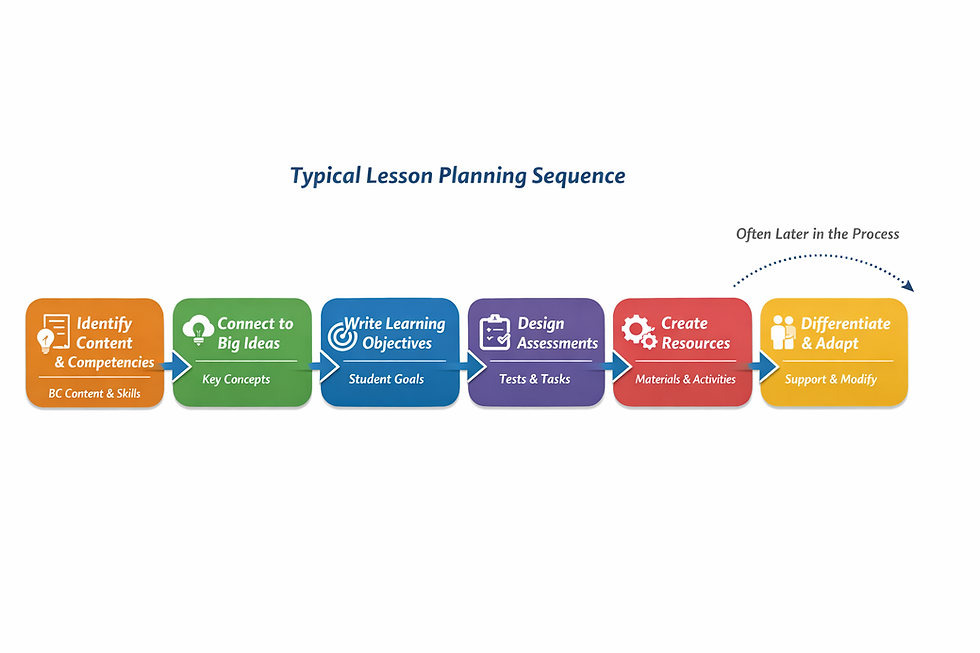
Stepping back into detachment allowed me to identify broader system-level patterns. One key insight was that differentiation can unintentionally become an add-on rather than a design foundation. When it appears at the end of planning, it often takes the form of modifications layered onto an existing lesson. I previously assumed time was the primary barrier. Through this process, I began to see that planning workflow and sequencing may be equally important.
Overall, this empathy work helped me shift from viewing differentiation as a strategy problem to understanding it as a design and systems problem. If differentiation is to be sustainable, teachers need support in embedding it earlier in planning, rather than adding it after lessons are already designed.
References
Kouprie, M. & Sleeswijk Visser, F. (2009). A framework for empathy in design: Stepping into and out of the user's life, Journal of Engineering Design, 20(5), 437-448.
Image was created using

Comments